
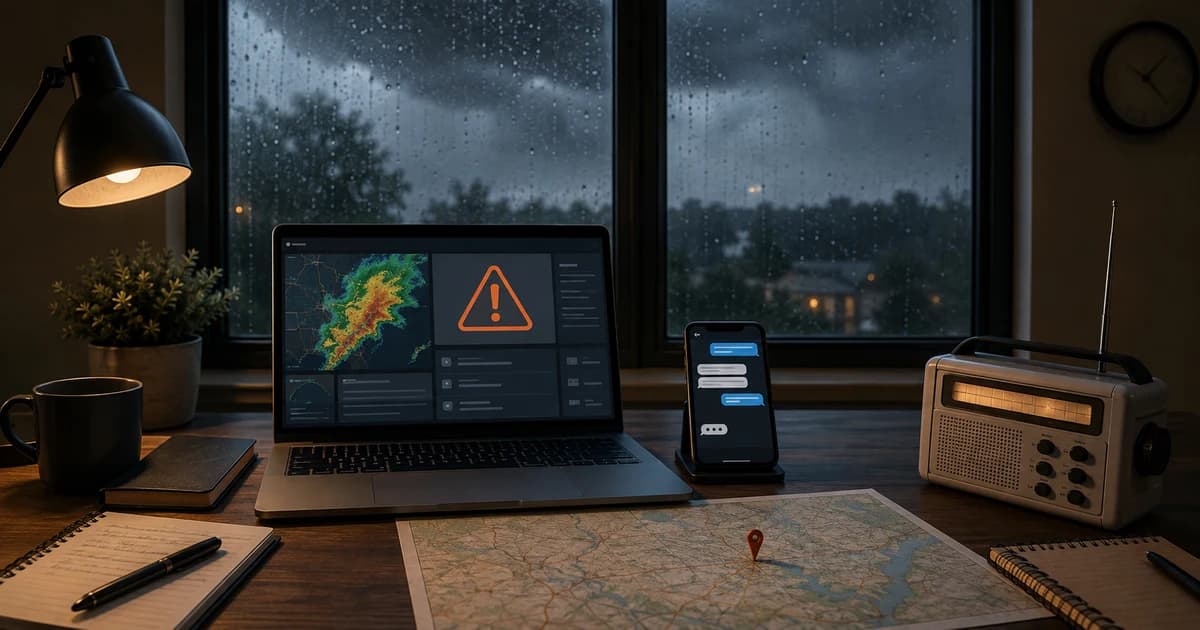
Severe-weather triggers for STR guest-message escalation
Which source and timing fields help a remote STR support coordinator distinguish a weather question from a safety escalation?
Research question: Which source and timing fields help a remote STR support coordinator distinguish a weather question from a safety escalation? The method does not forecast weather or replace official alerts. [Source: Emergency Alerts]
Severe-weather triggers for STR guest-message escalation
Methodology
- This analysis studies one inbound or outbound guest thread connected to an official weather alert, an operator instruction, or a reported condition at a booked property. The unit starts when the message enters the support queue and ends when the question is answered from an approved fact, escalated to the operator, or transferred to an emergency path. General travel-planning questions without a named property and time window are excluded. The research question is deliberately about message routing. It does not assess structural safety, predict storm movement, recommend evacuation, or decide whether a reservation should continue. Those judgments require official information and accountable local authority.
- FEMA and National Weather Service pages are the primary public sources for alerts and hazard-specific safety information. Airbnb's communication and host-ground-rule pages establish the platform context for timely, accurate guest communication. CISA and NIST sources address message authenticity, account protection, and incident records because a high-urgency request can still be false or misrouted. State Department traveler guidance contributes a general principle of maintaining current destination information, not a domestic STR rule. Each publication remains in its own lane. The local study tests only whether a coordinator can reproduce the source, timing, property context, and authorized action behind a message.
- Freeze the observation window and define the property's local time before classifying threads. Capture the guest's question, message timestamp, stay stage, property reference, official alert source and issue time when relevant, operator instruction version, known property-specific fact, missing fact, reply status, escalation owner, and next review time. Preserve URLs or alert identifiers rather than copying an undated summary. Record whether the message concerns general awareness, travel disruption, a condition at the property, an immediate threat, or a request involving money or policy. Ambiguous messages stay ambiguous until the authorized owner decides; the reviewer should not infer location or danger from tone alone.
- Measure counts and elapsed intervals by route class, but keep their denominators visible. Review false escalations, late escalations, replies based on expired notices, and messages that were accurate when drafted but stale when sent. A sensitivity check should remove the largest event or property cluster to see whether one storm dominates the result. Compare official-source age at drafting with source age at sending, since a scheduled reply can become outdated. Do not convert a response interval into a safety outcome or attribute a guest decision to one message. The most informative counterexample is a calm-sounding question tied to immediate local danger, or an urgent message based on an old alert.
- Weather alerts, delivery channels, geographic boundaries, and local orders can change quickly. A public web page may not reflect the guest's exact location or property condition, and a remote assistant may not know whether power, roads, alarms, or communications are functioning. Message timestamps can be delayed. This method cannot validate a building, interpret an emergency order, promise transportation, or replace 911, local authorities, property professionals, an insurer, or platform support. It also cannot produce a general incident rate from a convenience sample. The operator must define who can send safety instructions, make reservation decisions, approve expenses, and communicate when the usual channel fails.
Findings
- FEMA describes multiple ways people may receive emergency alerts, while the National Weather Service publishes hazard-specific safety information. These sources support linking a message to an identifiable official notice rather than paraphrasing an unattributed forecast. Airbnb's ground rules support timely communication but do not turn a coordinator into an emergency authority. Facts should therefore be written narrowly: which source issued what information, for which area, at what time, and what the operator has authorized the support lane to communicate. A guest's reported property condition is another source and should not be overwritten by a general regional notice. [Sources: Emergency Alerts; Weather Safety; Ground rules for home hosts]
- Timing creates the central operating problem. A correct alert copied at 8 a.m. can be wrong for a 2 p.m. send, while an operator instruction can remain valid only until a named review point. The proposed record attaches an as-of time to both external information and internal direction. Scheduled messages about affected stays require a freshness check before release. This analysis extends Airbnb's scheduled-message context; Airbnb does not claim that its automation verifies weather or property facts. A human decision owner remains necessary whenever the message changes access, cancellation, relocation, spending, or safety instruction. [Sources: Create scheduled quick replies; Manage all your Airbnb messages]
- STRVirtualAssistant can monitor an approved source list, match an alert area to a property record, draft a time-stamped factual summary, identify missing property information, and route the case. It should not interpret radar, tell a guest to shelter or evacuate without an authorized source and rule, promise reimbursement, or suppress a guest's firsthand report because it conflicts with a dashboard. Suspicious account or payment messages remain on the security path even during a weather event. The daily routine should expose the next update time and channel fallback so unresolved threads do not disappear when ordinary scheduling is disrupted. [Sources: Recognize and report phishing; Computer Security Incident Handling Guide]
- Evidence-led conclusion: A weather-related guest message is reviewable when source identity, issue time, property context, observed conditions, authorized instruction, and next review remain connected. Fast replies based on stale or mismatched information should count as defects, not successes. Local analysis can reveal which fields go missing and whether a freshness check catches expired drafts. It cannot show that the workflow kept anyone safe or establish a universal response target. The operator owns decisions about occupancy, access, reservations, money, and emergency communication; public authorities and qualified professionals own the underlying warnings and technical judgments. [Sources: Traveler's Checklist; Federal plain language guidelines]
Research standards
Every review freezes its observation window before findings are calculated. Reviewers retain a row-level evidence ledger with the original artifact reference, timestamp, responsible role, status at cutoff, correction history, denominator, exclusions, and unresolved cases. Ambiguous records are coded independently before reconciliation, and both readings remain visible until an accountable adjudicator applies a documented rule. Missing information is treated as unknown rather than silently classified as success or failure. Sensitivity checks remove major record classes in turn so a pattern that depends on one owner, channel, event type, or reporting cycle is disclosed instead of presented as stable. Elapsed time is not translated into labor, an association is not described as causation, and local observations are not converted into external benchmarks.
Interpretation begins with counterexamples and the cases still open at the cutoff. A formally complete record may lack usable evidence, while an authorized alternative path may achieve the intended outcome without matching the expected workflow. The review therefore states the strongest alternative explanation, identifies the additional artifact that could distinguish it from the preferred reading, and records what would reverse or retire the resulting operating rule. Comparisons use the same field definitions and equivalent work classes; a material change in coverage, tooling, policy, or sample composition creates a new baseline rather than a trend. Follow-up records name the decision taken, responsible owner, anticipated signal, review date, exception path, and evidence required before a stronger intervention can be justified.
Governance checks keep only information necessary for the research question. Sensitive content is replaced with a controlled reference whenever an authorized reviewer can reproduce the classification without holding a copy. Access boundaries, retention expectations, correction ownership, disputed-interpretation routes, duplicate handling, spanning-record rules, and cutoff treatment are documented before release. Absolute counts appear beside percentages, small samples avoid false precision, and every external statement links to a listed source without implying that the publication measured the local record set. The proposed action must be proportionate, reversible, and reviewable. If the available evidence cannot support it, the gap becomes an explicit evidence request rather than an assumption.
This research note supports the STR Virtual Assistant topical map for vacation-rental guest communication, property readiness, issue routing, and evidence-based operational follow-through.
Sources
- Emergency AlertsFederal Emergency Management Agency
- Weather SafetyNational Weather Service
- Ground rules for home hostsAirbnb
- Manage all your Airbnb messagesAirbnb
- Create scheduled quick repliesAirbnb
- Recognize and report phishingCybersecurity and Infrastructure Security Agency
- Require multifactor authenticationCybersecurity and Infrastructure Security Agency
- Computer Security Incident Handling GuideNational Institute of Standards and Technology
- Federal plain language guidelinesPlainLanguage.gov
- Traveler's ChecklistU.S. Department of State